

1. Introduction
The brushless vs brushed fuel pump debate is really a question of where each technology earns its keep. Brushed pumps are the mature, low-cost standard with a simple two-wire hookup; brushless pumps move the commutation into an electronic controller and trade a higher unit price for longer life and lower returns. This post compares them on the factors that actually move a distributor’s P and L – current draw, heat, lifespan, failure rate, MOQ, and controller compatibility – so the choice becomes a sourcing decision rather than a guess.
2. What Is a Brushless Fuel Pump
A brushless fuel pump uses an electronically commutated motor. Instead of carbon brushes sliding against a commutator, a controller switches the stator windings with transistors, using rotor position from a sensor or a sensorless algorithm. There is no brush wear path, so the main wear items are the bearing and the impeller. In B2B terms this matters because the pump runs cooler and longer under continuous duty, which is why brushless designs show up in OEM, performance, and private-label programs where uptime drives repeat orders.
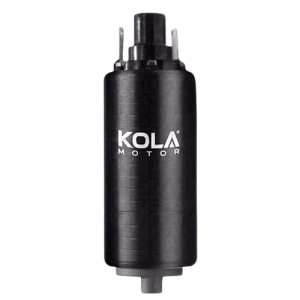
3. What Is a Brushed Fuel Pump
A brushed fuel pump uses a DC motor with carbon brushes pressed against a copper commutator. As the armature spins, the brushes deliver current and the commutator flips the field to keep it turning. This is a mature, low-cost design with a simple two-wire connection – no external controller required. The trade-off is brush and commutator wear: under heavy or continuous load the brushes erode and sparking rises, which limits service life and raises the chance of noise and returns over time.
4. Brushless vs Brushed: Key Differences
Motor Structure and Commutation
Brushed motors carry the commutator and brushes inside the motor can; brushless motors move commutation outside to a controller and keep only the wound stator and rotor inside. That structural split is the root of every other difference below, because wear and heat now live in different places.
Efficiency and Current Draw
Brushless commutation loses less energy to friction and arcing, so for the same flow and pressure a brushless pump typically draws less current. The gain is most visible at part load and under hot-fuel conditions. Brushed pumps are efficient enough for intermittent duty but lose more to brush friction and commutator resistance as they age, so their current draw and heat climb with use.
Noise and Heat Generation
Brushed pumps arc at the commutator, which adds electrical noise and localized heat. Brushless pumps run quieter electrically and shed heat through the controller rather than inside the fuel, which helps in in-tank applications where the fuel itself is the coolant. Less in-can heat also means a smaller thermal margin to design around.
Lifespan and Failure Rate
Because there is no brush to wear, a brushless pump’s wear is dominated by bearing life and the controller, not by a consumable contact. Brushed pumps fail progressively as brushes thin and commutator grooves deepen. Illustrative field data from distribution programs puts brushed service life in the lower thousands of hours and brushless designs higher, but confirm exact ratings against the supplier’s endurance test report before you quote a number to a customer.
Cost and Minimum Order Quantity
Brushed pumps win on unit price and on simple, low-MOQ ordering – the motor is cheap to build and needs no companion controller. Brushless pumps cost more per unit because of the controller and tighter motor build, and MOQ can be higher for custom or private-label runs. For distributors, the math is margin per unit versus return cost per unit, not sticker price alone.
Controller and Compatibility Requirements
A brushed pump connects with two wires and works with any 12V or 24V supply in its range. A brushless pump needs a compatible controller – often supplied with the pump or built into the assembly – and the correct voltage and PWM or signal spec. Mismatched controllers cause startup and noise problems, so confirm the controller comes with the SKU or is sourced as a matched pair. This is the single most common compatibility mistake distributors hit when first adding brushless to a line.
5. Which One Fits Your Business Needs
Match the motor type to the segment. If your customers run intermittent, price-sensitive, or classic-car low-pressure builds, low-pressure fuel pumps in brushed form keep cost and support simple. If you serve performance, OEM, or continuous-duty buyers who care about warranty returns and runtime, high-performance fuel pumps in brushless form protect your margin through lower return rates. Many distributors stock both: brushed for volume and brushless for the premium tier, then let warranty data guide the mix over time.
Source brushless and brushed pumps from one B2B partner
KOLA MOTOR builds brushless, brushed, and low-pressure pumps with flow and pressure validation, private-label support, and a 5-step QC process from incoming inspection to final traceability.
6. FAQs
Are brushless fuel pumps worth the extra cost for distributors?
For distributors serving performance, OEM, or continuous-duty segments, yes – the lower return rate and longer runtime usually recover the higher unit cost through fewer warranty claims and steadier reorder flow. For pure low-price volume where brush wear is acceptable, brushed stays competitive. Treat it as a segment decision, not a blanket rule, and model returns into the margin before you commit to a mix.
Do brushless fuel pumps require a separate controller?
Most do. A brushless motor cannot run from a plain two-wire supply; it needs an electronic controller to commutate the windings. Some suppliers ship the controller inside the pump housing or as a matched external module, so confirm whether the controller is included with the SKU or must be sourced separately before you list it. The brushless fuel pump controller requirement is the first thing to verify on a datasheet.
Can brushed fuel pumps be replaced directly with brushless models?
Not as a drop-in in most cases. Beyond the physical fit, brushless pumps need a controller and the correct voltage and signal spec, while brushed pumps use a simple two-wire connection. A direct swap also changes current draw and thermal behavior, so re-validate the harness, fuse, and fuel system before substituting one for the other. Whether brushed fuel pumps can be replaced with brushless depends on the surrounding electrical and mechanical design.
Which fuel pump type has lower warranty return rates?
In distribution programs that track returns, brushless pumps tend to show lower return rates because there is no brush or commutator to wear out. The caveat is controller-related failures, which is why a matched, validated controller matters. Brushed pumps return more often as brushes and commutators age under heavy use, so expect higher long-run warranty cost on brushed volume.
7. Conclusion
Neither brushless nor brushed is universally better – the right choice is the one that fits your customer segment, margin, and warranty tolerance. Brushed pumps lead on price and simplicity; brushless pumps lead on lifespan, efficiency, and return rate. A balanced distributor line often carries both, using brushless for the premium and continuous-duty tier and brushed for value volume, then shifts the mix as warranty data comes in. For a configurable sourcing plan, review the brushless, high-performance, and low-pressure categories together before your next order.
