

For B2B buyers at the selection, procurement, or supplier-evaluation stage, the choice between an electric fuel pump and a mechanical fuel pump is rarely just about the part itself. It shapes unit cost, total cost of ownership, maintenance intervals, and how flexibly you can source and reorder. As a specialized fuel pump manufacturer serving distributors, OEM programs, and performance brands, KOLA MOTOR sees these two architectures specified for very different product lines. This comparison lays out the trade-offs in plain procurement terms so you can match the right pump type to your application and forecast.
What Is a Mechanical Fuel Pump
A mechanical fuel pump is driven by the engine, not by electricity. In most classic and carbureted applications it mounts on the engine block and is actuated by a pushrod or eccentric lobe on the camshaft, which flexes a diaphragm to draw fuel from the tank and push it to the carburetor. Because it only runs when the engine turns, it delivers modest, regulated low pressure – typically well under 0.5 bar – which is exactly what a carburetor needs. There are no brushes, no controller, and no in-tank motor to fail from heat or contamination, which is why these pumps remain a staple for restoration, marine, and small-engine programs. Buyers building carbureted lines should review low-pressure fuel pumps for stable, low-pressure delivery that suits mechanical and diaphragm designs.
What Is an Electric Fuel Pump
An electric fuel pump uses a small electric motor – either brushed or brushless – to move fuel, most often from inside the tank (in-tank) or inline along the fuel line. Because it is independent of engine speed, it can deliver the higher, steadier pressure that electronic fuel injection (EFI) demands, commonly in the 3 to 5 bar range, with flow that supports modern engine management. Brushless designs add electronic commutation for cooler running and longer service life. KOLA MOTOR engineers a full range of brushless fuel pumps for EFI and performance applications, with flow and pressure-curve support so buyers can select against a real datasheet rather than a guess.
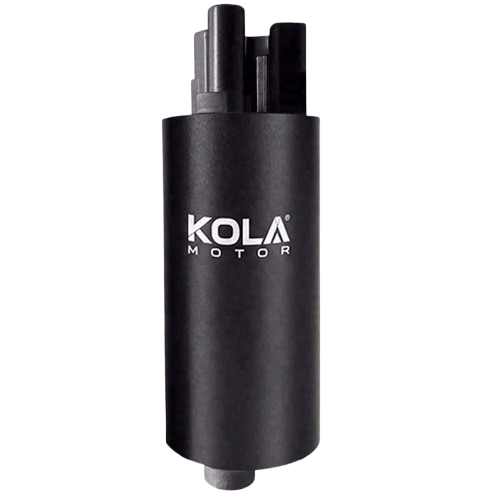
Electric vs Mechanical Fuel Pump: Key Differences
The two pump types diverge on five axes that matter to a buyer: how they work, what they cost over time, how long they last, how you source them, and which fuel system they serve. The table below summarizes the practical contrast.
Working Principle and Fuel System Compatibility
A mechanical pump is a positive-displacement diaphragm device synchronized to the engine; an electric pump is a motor-driven impeller or gerotor device powered by the vehicle electrical system. That single difference decides compatibility. Mechanical pumps pair naturally with carbureted systems where pressure must stay low and pulsation is tolerated. Electric pumps pair with EFI, where precise pressure and on-demand flow are required. Mixing them up is a common sourcing error: specifying a mechanical pump for an EFI rail, or an electric pump where only low pressure is allowed, creates returns and warranty risk.
Cost per Unit and Total Cost of Ownership
At the unit level, a basic mechanical pump is usually the cheaper component: fewer parts, no motor, no electronics. An electric pump carries motor, controller, and sometimes brushless drive electronics, so the sticker price is higher. Total cost of ownership (TCO) tells a more useful story for procurement. Mechanical pumps are cheap to replace but tied to engine service; electric pumps concentrate cost in the module but enable remote mounting, diagnostics, and longer service intervals. Illustrative figures vary widely by program, so treat any single number as a planning estimate and confirm against the supplier’s latest quote. For performance and EFI lines, high-performance fuel pumps are priced against duty cycle and flow rating rather than against a mechanical baseline.
Lifespan and Failure Modes
Mechanical pumps wear at the diaphragm, lever, and valve springs; failure is usually a slow pressure drop or external weep rather than a sudden stop, which is forgiving in field service. Electric pumps fail differently – motor brush wear (on brushed units), controller faults, or contamination-related seizure – and a failure can be abrupt. Brushless electric pumps remove the brush-wear mode and, with good thermal and contamination control, can outlast a brushed unit substantially. KOLA MOTOR validates selected development programs for up to 2,000 hours of continuous endurance, and every pump passes a 5-step QC process: incoming material inspection, assembly process control, flow and pressure validation, leak, noise, and electrical testing, and final inspection with traceability.
Minimum Order Quantity and Sourcing Flexibility
Sourcing flexibility is where the two types feel very different to a buyer. Mechanical pumps, being simpler and often commodity-style, can sometimes be sourced at lower MOQ from general suppliers. Electric pumps – especially brushless or custom-housing variants – tend to carry higher MOQ because of motor winding, controller, and validation tooling. The offset is customization: electric programs more readily accept flow-curve, connector, harness, filter, housing, packaging, and logo changes under OEM, ODM, or private-label terms. Always confirm MOQ, lead time, and reorder terms in writing before the first order.
Suitability for EFI vs Carbureted Systems
The rule of thumb is straightforward. Carbureted and many classic, marine, and small-engine applications: mechanical or low-pressure electric delivery. EFI, modern performance, and anything with a pressure regulator and return or returnless rail: electric, preferably brushless for duty and life. Distributors serving both segments should stock the architecture each segment expects rather than forcing one type across the catalog.
| Aspect | Mechanical fuel pump | Electric fuel pump |
|---|---|---|
| Drive source | Engine camshaft / eccentric | Electric motor (brushed or brushless) |
| Typical pressure | Low, under 0.5 bar | Higher, commonly 3 to 5 bar |
| Best fuel system | Carbureted, classic, small engine | EFI, performance, modern engines |
| Unit cost | Generally lower | Generally higher (motor + electronics) |
| Failure mode | Gradual pressure loss, external weep | Abrupt on motor or controller fault |
| Sourcing / MOQ | Often lower MOQ, less customizable | Higher MOQ, strong customization |
Choosing the Right Pump Type for Your Product Line
Start from the fuel system your customers run, then optimize cost and supply around it. If your catalog is built on carbureted, restoration, marine, or small-engine demand, a mechanical or low-pressure electric strategy keeps unit cost down and service simple. If you serve EFI, tuning, or OEM programs, standardize on electric – and lean toward brushless where duty cycle and lifespan justify it. For private-label or mixed programs, weigh MOQ and customization headroom: electric platforms usually absorb logo, connector, and flow changes more readily, while mechanical platforms win on entry price and reorder simplicity. Match the pump to the segment before you compare prices, and confirm every specification against the supplier’s current datasheet.
Specify high-performance fuel pumps with KOLA MOTOR
Request flow curves, pressure data, and private-label pricing for EFI and performance electric fuel pumps built to your specification.
Frequently asked questions
Why are mechanical fuel pumps still used in some applications?
Mechanical pumps persist because they suit carbureted and low-pressure systems where steady, modest delivery is all that is needed. They have no motor or controller to fail from heat or electrical faults, they are cheap to produce, and they are mechanically simple to service in the field. For classic-car restoration, marine, and many small-engine programs, they remain the pragmatic, low-cost choice.
Does an electric fuel pump justify a higher unit cost?
Often yes, when the application requires EFI-level pressure and flow or benefits from longer service life and diagnostics. The higher unit price funds the motor, controller, and validation that mechanical pumps cannot provide. Whether the premium pays back depends on duty cycle, failure-cost exposure, and maintenance intervals – so evaluate total cost of ownership, not just the sticker price, and confirm figures with the supplier’s quote.
Can mechanical fuel pumps be upgraded to electric systems?
Yes, in many vehicle conversions a low-pressure mechanical pump is replaced by an in-tank or inline electric pump to support EFI conversion, often with an added regulator and relay harness. The conversion is common for carbureted-to-EFI swaps, but it requires matching pump pressure and flow to the new injector and rail requirements, plus correct wiring and fuel-line changes. Engineering review is recommended before specifying.
How does MOQ typically differ between the two pump types?
Mechanical pumps, being simpler and closer to commodity designs, are often available at lower minimum order quantities from general suppliers. Electric pumps – particularly brushless or custom-housed variants – usually carry higher MOQ because of motor winding, controller, and validation tooling. The trade-off is that electric programs more easily accept customization such as flow curve, connector, and private-label packaging, which can justify the larger first order for a branded line.
Conclusion
Neither pump type is universally better – the right answer follows the fuel system and the buyer’s cost and supply priorities. Mechanical pumps win on entry price, simplicity, and low-pressure compatibility; electric pumps win on EFI capability, lifespan, and customization headroom. For distributors building a carbureted or classic line, low-pressure delivery remains the practical anchor, while EFI and performance programs should standardize on electric, preferably brushless. Align MOQ, lead time, and customization terms with your forecast before committing.
Source low-pressure fuel pumps for your carbureted line
From mechanical-style low-pressure delivery to custom electric assemblies, KOLA MOTOR supports OEM, ODM, and private-label programs with full validation.
