

For performance and racing modification parts distributors, and for tuner-shop buyers building fuel systems for customers, the choice between a high-flow and a standard-flow brushless fuel pump is not about which is “better” – it is about matching flow to the engine’s actual demand. This buyer’s guide explains how flow is defined, what each pump type is built for, where they differ, and how to select the right unit by engine power, fuel type, and modification level. It draws on brushless fuel pumps developed for continuous-duty B2B programs.
1. Introduction
Distributors and tuner shops see both pump types on the same shelf, often from the same housing family, and the price gap can be large. The practical question from a buyer is simple: when does a standard-flow pump cover the job, and when is a high-flow unit required? This guide gives a structured way to answer that, using working-pressure flow numbers rather than free-flow marketing figures, so quotes and stock decisions hold up in the field.
2. What Defines Flow Rate in a Brushless Fuel Pump
Flow rate is the volume of fuel a pump can move in a given time, expressed as liters per hour (L/h) or gallons per hour (GPH). The number only means something when it is stated at a working pressure, because a pump’s free-flow rate measured at zero pressure is always far higher than what it delivers against the fuel rail. A brushless pump uses electronic commutation instead of a mechanical commutator, which lets it hold a flatter flow curve as pressure and load rise.
In a B2B datasheet, look for flow rated at a realistic working pressure – for example L/h at 3 bar (about 43.5 psi) or at 5 bar for forced-induction builds – plus the current draw at that point. That “flow at working pressure” figure is the one to compare between a standard-flow and a high-flow unit. KOLA MOTOR publishes flow and pressure curves per model so distributors can match a pump to an engine instead of guessing from a headline number.
3. What Is a Standard-Flow Brushless Fuel Pump
A standard-flow brushless pump is the workhorse for stock replacement and mild modifications. Illustrative values for this class are around 150 to 200 L/h at 3 bar, with a modest current draw of roughly 5 to 8 amps at 13.5 V. Those figures comfortably support naturally aspirated and lightly boosted engines near original output, plus daily-driven and fleet applications where quiet operation and long life matter more than maximum horsepower.
For distributors, standard-flow units are usually the easier stock line: lower unit cost, smaller MOQ, and broad application coverage across common vehicle platforms. They are the right default for OEM-replacement programs and for customers who are not increasing engine power. Engineered by the KOLA MOTOR manufacturing program, these pumps still pass the 5-step QC process – incoming inspection, assembly control, flow and pressure validation, leak, noise, and electrical testing, and final inspection with traceability.
4. What Is a High-Flow Brushless Fuel Pump
A high-flow brushless pump is built for forced induction, E85, and higher horsepower targets. Illustrative values are 300 L/h and above at 3 to 5 bar, with current draw in the range of 15 to 20 amps at 13.5 V. That extra flow headroom covers the fuel-volume increase that boost and alcohol-based fuels demand, and it lets the pump sit lower on its curve at a given load, which reduces heat and extends life under hard use.
High-flow units belong in high-performance fuel pumps programs where the engine has been modified for more power. They typically need upgraded wiring, a proper controller or driver module, and correct fuel-line sizing, so they are sold as part of a system rather than a drop-in swap. For a distributor, the trade is higher unit cost and often a higher MOQ in exchange for covering the performance and motorsport segment.
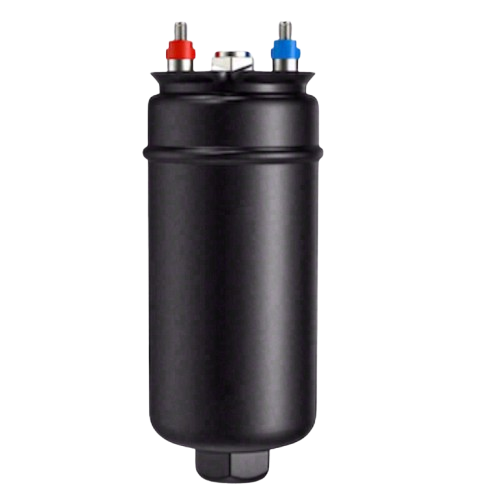
5. Key Differences Between High-Flow and Standard-Flow Brushless Pumps
The table below summarizes the practical differences a buyer should weigh. The values are illustrative class ranges; always confirm exact figures on the current datasheet before procurement.
| Attribute | Standard-Flow | High-Flow |
|---|---|---|
| Flow at 3 bar (illustrative) | 150 to 200 L/h | 300 L/h and above |
| Current at 13.5 V (illustrative) | ~5 to 8 A | ~15 to 20 A |
| Typical application | OEM replacement, mild mods | Turbo, supercharger, E85, track |
| Install requirement | Often direct replacement | Upgraded wiring, controller, lines |
| Unit cost and MOQ | Lower cost, lower MOQ | Higher cost, higher MOQ |
Flow Rate at Working Pressure
This is the headline difference. Two pumps may show similar free-flow numbers but diverge sharply at 3 or 5 bar. Always compare the “flow at working pressure” line on the curve, not the open-flow figure, because that is what the engine actually receives at the rail.
Current Draw and Voltage Requirements
High-flow pumps draw roughly two to three times the current of a standard-flow unit at the same voltage. That affects wiring gauge, relay and fuse sizing, and the controller or driver module. Undersized wiring causes voltage drop, which lowers delivered flow and generates heat. Spec the electrical side for the high-flow figure even if the first build is modest.
Application Range: OEM Replacement vs Performance Builds
Standard-flow pumps cover stock and near-stock engines and the bulk of replacement demand. High-flow pumps cover builds where power has been raised – larger turbo, supercharger, aggressive tune, or alcohol fuel. Mixing them up means either a pump that cannot support the power (lean condition risk) or an oversized pump that runs hot and wastes budget on a stock engine.
Heat and Noise Under Continuous Duty
Brushless designs run cooler and quieter than brushed pumps at the same load, which is why both types suit continuous duty. A high-flow pump running at half load stays cooler than a standard-flow pump pinned at full load, so for sustained high-power use the high-flow unit is often the safer thermal choice. Endurance validation – up to 2,000 hours on selected programs at KOLA MOTOR – is the evidence buyers should ask for.
Price and MOQ Differences
High-flow pumps cost more per unit and usually carry a higher MOQ because of the controller and heavier motor. Distributors should balance stock: carry standard-flow as the volume line and high-flow for the performance segment, rather than over-investing in high-flow inventory for a mostly stock customer base.
Request brushless pump flow curves for your lineup
Get model-by-model flow and pressure data, sample evaluation, and private-label options for brushless fuel pumps.
6. How to Match Flow Rate to Your Customers’ Applications
Use a simple, repeatable selection path so every quote is defensible:
- Start from engine power target and forced induction. A stock or lightly modified NA engine usually fits a standard-flow pump; a turbo, supercharger, or high-horsepower build needs high-flow headroom.
- Account for fuel type. E85 and other alcohol blends need roughly 30 percent more flow than gasoline for the same power, because they carry less energy per liter. This alone can move a build from standard-flow to high-flow.
- Read the flow curve at the planned working pressure, not free flow, and add margin for hot weather, voltage drop, and future upgrades.
- Size the electrical side – wiring, relay, fuse, and controller – for the high-flow current figure so the pump actually delivers the rated flow.
- For carbureted or low-pressure return-style systems, review low-pressure fuel pumps for stable low-pressure delivery instead of a high-pressure unit.
KOLA MOTOR supports this step with custom flow-curve, pressure, connector, harness, filter, and housing options, plus OEM, ODM, and private-label programs, so distributors can offer a matched pump rather than a generic part number.
7. Frequently Asked Questions
How is fuel pump flow rate measured and rated?
Flow is measured by running the pump against a calibrated load and recording volume over time, then stated as L/h or GPH at a specific pressure – such as at 3 bar or 5 bar – using a known voltage like 13.5 V. Reputable B2B suppliers rate flow at working pressure and back it with a flow curve, not just an open-flow peak, and validate each unit during production testing.
Does a higher flow pump always mean better performance?
No. Oversizing flow on a stock engine wastes budget, can run the pump outside its efficient range, and adds electrical load you then have to support. “Better” means matched to demand with margin. A standard-flow pump correctly sized beats an oversized high-flow pump that is poorly wired or unnecessary for the build.
What flow rate is typically needed for turbocharged or E85 builds?
Illustratively, turbocharged gasoline builds often move into the 300 L/h-and-above class at working pressure, and E85 adds roughly another 30 percent flow on top of the gasoline requirement for the same power. The exact number depends on target horsepower, boost, and fuel; confirm against a flow curve and add margin rather than quoting a single fixed figure.
Can standard-flow pumps be upgraded to high-flow within the same housing?
Sometimes. Some platforms share a housing between flow classes via a different motor or internals, which helps distributors standardize brackets and hangers. It is not universal, and the electrical side still has to support the higher current. Confirm with the supplier whether the specific housing offers both flow classes before promising a swap-in upgrade to customers.
8. Conclusion
High-flow and standard-flow brushless fuel pumps are not ranked by quality – they are sized by job. Standard-flow covers OEM replacement and mild modifications at lower cost and MOQ; high-flow covers forced induction, E85, and high-power builds where flow headroom protects the engine and the pump. Match the pump to working-pressure flow, fuel type, and mod level, and size the wiring for the high-flow figure. For distributors building a complete program, pair the right pump class with matched hangers and assemblies and validated flow data so every sale is defensible.
Build your high-flow and standard-flow pump range with KOLA MOTOR
From stock-replacement standard-flow units to high-flow performance pumps, with flow curves, samples, and private-label support for your market.
