

Introduction
When distributors, performance brands, and EFI-system OEMs validate a new fuel delivery component, the conversation quickly moves past catalog photos and lands on hard numbers: flow at working pressure, current draw, controller compatibility, and the validation data a supplier can actually produce. A brushless EFI fuel pump is one of the few fuel-system parts where the control electronics matter as much as the hydraulic core. This guide explains how a brushless brushless EFI fuel pump works and lays out the selection criteria procurement and engineering teams should use before requesting samples or committing to a bulk purchase.
What is a Fuel Pump and What is an EFI Fuel Pump
The simplest answer to what is a fuel pump is that it is a positive-displacement or centrifugal device that moves fuel from the tank to the engine at a controlled pressure and volume. In a carbureted engine the pump only needs to keep a low, roughly constant head of fuel at the float bowl. An EFI fuel pump, by contrast, must deliver fuel against the much higher and tightly regulated pressure that electronic fuel injectors require.
So what separates a generic pump from an efi fuel pump? Two things: a pressure range matched to the injector rail (commonly 3.0 to 5.0 bar for port injection, with returnless systems regulating at the rail or in the module) and a flow curve that holds up across the vehicle’s full voltage and temperature envelope. Efi fuel pumps are selected against the engine’s peak injector demand plus a margin for pressure drop, filter restriction, and hot-fuel conditions, not against a single rated point.
How Does a Fuel Pump Work in an EFI System
Understanding how does a fuel pump work in this context means following the fuel path: the pump draws fuel from the tank through a strainer, pressurizes it, and pushes it through the line to the injector rail. A pressure regulator (or the controller in a returnless design) holds the rail pressure near the target, and excess fuel returns to the tank or is simply not pumped. The engine control unit meters each injector pulse; the pump’s job is to never be the limiting factor.
Pressure and Flow Requirements of EFI Fuel Pumps
Flow and pressure are coupled. A pump rated at 255 LPH free flow may deliver far less at 4 bar working pressure, and that working-pressure number is the one that matters for sizing. As a rule, size the pump for peak injector flow at the worst-case battery voltage (often around 11 V under cranking or heavy electrical load) plus a safety margin. Undersizing shows up as fuel pressure sag under wide-open throttle; oversizing wastes current and adds heat.
Why Flow Stability Matters for Injectors
Electronic injectors are calibrated to deliver a precise mass of fuel per millisecond at a known rail pressure. If pump output droops as the fuel warms or voltage dips, the ECU cannot fully compensate, and the air-fuel ratio drifts. Stable flow at working pressure is therefore not a comfort feature; it is what keeps the engine in its tuned window. This is the single most important hydraulic property to verify on any candidate efi fuel pump.
What Makes an EFI Fuel Pump Brushless
The defining difference of a brushless unit is that it replaces the carbon brushes and commutator of a conventional motor with electronic commutation. The rotor carries permanent magnets; external circuitry switches the stator windings in sequence to keep the magnetic field pulling the rotor around. KOLA MOTOR builds 255 LPH universal in-tank brushless performance fuel pumps and similar families around this architecture.
Electronic Commutation and Rotor Drive
Because there is no brush-to-commutator contact, there is no arcing, no brush wear, and no brush dust contaminating the fuel. Commutation is handled by a controller that senses rotor position (via hall sensors or sensorless back-EMF) and energizes the correct winding. This is why a brushless pump is never a drop-in mechanical duplicate of a brushed pump; it is a motor-plus-driver system.
Fuel Intake and Pressurization
Mechanically, the pump still draws fuel through an inlet strainer and uses an impeller or gerotor stage to raise pressure before the outlet. The brushless design simply changes how the drive stage is powered and controlled. The hydraulic end is selected for the target flow and pressure class, exactly as with any other efi fuel pump.
Speed Control via Controller
The companion controller can vary motor speed with a PWM or DC command. That lets the system run the pump only as fast as needed, trimming current and heat during low-demand cruising and ramping up for high load. Speed control is the feature that makes brushless pumps attractive for returnless EFI architectures and for OEMs who want demand-based fuel delivery.
Brushless vs Brushed EFI Fuel Pumps: Key Differences
For a purchasing decision the comparison has to be concrete. The points below are the ones engineering and procurement should score against each other.
Efficiency and Heat
Brushless motors convert more electrical input into hydraulic output and shed less energy as heat in the motor itself. Less heat in the tank means cooler fuel and a lower vapor-lock risk, an advantage in hot-climate or returnless packaging.
Wear and Service Life
With no brushes to erode, a brushless pump avoids the dominant wear mechanism of a brushed unit. Field life is generally longer and more predictable, which matters to distributors managing warranty exposure and to OEMs specifying service intervals.
Noise and Vibration
Electronic commutation and smoother rotor drive typically produce less tonal noise and fewer vibrations transmitted through the tank. This is a frequent reason performance and premium vehicle programs choose brushless pumps.
Control Flexibility
Only a brushless pump supports true speed control. Brushed pumps are essentially on-or-off at a fixed voltage. If your EFI strategy wants variable delivery, brushless is the only option in this comparison.
Cost and Controller Requirement
The trade-off is cost and system complexity. Brushless pumps need a matched controller and careful wiring, while a brushed pump is simpler and cheaper to integrate. The right choice depends on whether the lifetime, efficiency, and control benefits outweigh the added controller and engineering cost for your program.
In-Tank and Inline EFI Fuel Pump Designs
Beyond the motor type, mounting geometry drives cooling, packaging, and which KOLA family fits your application.
In-Tank Mounting and Cooling
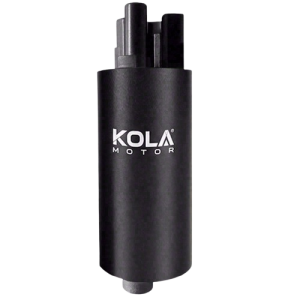
In-tank pumps are submerged in fuel, which cools the motor and suppresses noise. They are the default for most passenger and performance vehicles. KOLA’s 340 LPH universal in-tank brushless fuel pump is built for this environment, and the compact brushless in-tank motorcycle fuel pump serves smaller-volume tanks where space is tight.
Inline EFI Fuel Pump Packaging
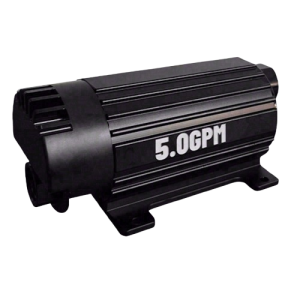
An inline efi fuel pump mounts outside the tank, typically along the chassis or frame rail, drawing fuel from the tank through a pickup. External mounting simplifies tank design and makes the pump easy to service, at the cost of losing fuel cooling and adding underbody packaging. For high-flow or E85 programs, KOLA’s 5.0 GPM universal external brushless E85 fuel pump is a representative external-brushless option. Choose inline when tank space, serviceability, or very high flow outweigh the cooling benefit of submersion.
OEM Selection Criteria for Brushless EFI Fuel Pumps
Use the following checklist when screening a supplier and preparing a sample-approval request. Each line should map to a number you can verify on the datasheet.
Required Flow at Working Pressure
Specify the flow you need at your actual rail pressure and your lowest expected supply voltage, not free-flow LPH. Ask the supplier for a flow-versus-pressure curve and a flow-versus-voltage curve. This is the first filter for any efi fuel pump candidate.
Operating Voltage and Current
Confirm the operating voltage range (12 V or 24 V systems differ) and the current draw at your working point. High current affects harness gauge, fuse rating, and relay selection. Request the current curve so your electrical team can size wiring correctly.
Fuel Type and Ethanol Compatibility
Match the pump’s wetted materials to your fuel. If you run E85 or high-ethanol blends, confirm explicit ethanol compatibility and the maximum blend the seals and internals tolerate. Do not assume a gasoline-rated pump is E85-safe.
Pump and Controller Matching
Because a brushless pump needs its controller, confirm the pump and controller are a validated pair or that the supplier documents the commutation and control interface. Mismatched pairing can cause poor starting, overheating, or premature failure. Treat the pump-and-controller as one component.
Port Size and Mounting Dimensions
Check inlet and outlet port size, thread or hose-barb type, overall length, and any orientation or clearance limits. A pump with the right flow but wrong ports creates a costly fabrication workaround. Provide your mechanical team the dimensional drawing early.
Validation Data to Request From the Supplier
Before sample approval, request the flow and pressure curves, current draw data, endurance or life-test summary, material compatibility statement, and dimensional drawings. A credible manufacturer should supply these as standard documentation. KOLA MOTOR supplies fuel pumps to global B2B distributors and OEMs and provides specification data for engineering review; always confirm the exact figures on the current datasheet for your selected model, as specifications can vary by variant.
FAQs
Q: Do brushless EFI fuel pumps need a dedicated controller?
A: Yes. A brushless motor requires external electronic commutation, so the pump must be paired with a compatible controller; treat the pump and controller as a single system.
Q: What flow and pressure data should OEMs request for EFI fuel pumps?
A: Request flow at your actual working pressure and at your lowest expected voltage, plus flow-versus-pressure and flow-versus-voltage curves, so sizing is based on real operating points rather than free-flow ratings.
Q: Are brushless EFI fuel pumps compatible with E85?
A: Only if the specific model is rated for it. Confirm explicit ethanol compatibility and the maximum blend with the supplier, since seals and wetted materials must be E85-rated.
Q: What documents should distributors request before listing a new EFI fuel pump?
A: Request the datasheet with flow and current curves, dimensional drawings, material compatibility statement, and any endurance or validation summary, then verify the figures against the exact SKU you intend to stock.
Request the Datasheet and a Sample for Your EFI Program
Confirm flow at working pressure, voltage, current, and controller matching with KOLA MOTOR engineering before you commit to a bulk order. Get the specification package and a sample quote for your application.
Conclusion
A brushless EFI fuel pump is best understood as a motor-and-controller system wrapped around a hydraulic core. Select it on working-pressure flow, voltage and current, fuel compatibility, and a validated pump-controller pair, then back the decision with supplier curves and validation data rather than headline LPH numbers. Screen candidates against the criteria above, confirm every figure on the current datasheet, and you can move from sample approval to bulk purchasing with confidence.
