

When a distributor plans a fuel pump program, one of the first sourcing decisions is the form factor: an in-tank unit that drops into the fuel tank, or an external unit mounted on the chassis. This guide frames the in-tank vs external fuel pump decision for inventory and selection buyers, comparing installation, cooling, flow, serviceability, and the practical realities of stocking and MOQ. The goal is a clear view of where each type fits a B2B distribution business.
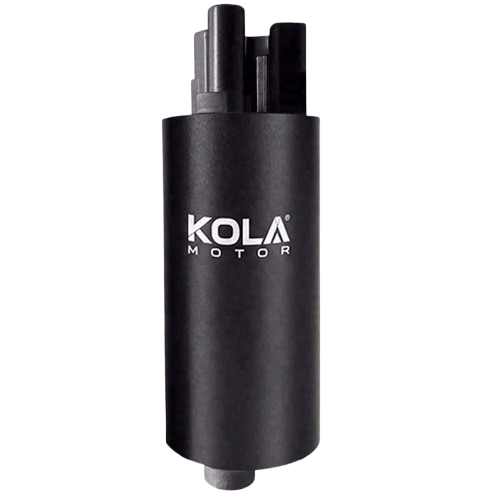
What is an in-tank brushless fuel pump
An in-tank brushless fuel pump is mounted inside the fuel tank, fully submerged in fuel. The brushless motor runs cooler because the surrounding fuel acts as both coolant and bearing lubricant, and the submerged location shields it from engine-bay heat and road noise. In B2B distribution, in-tank units are usually supplied as a bare pump (to drop into an existing sender housing), as part of a hanger assembly, or as a complete module. They suit most passenger cars, light trucks, and powersports platforms where the tank already provides the mounting point and the fuel level sender is integrated.
From a buyer’s view, the in-tank format is the high-volume, catalog-filling option: broad application coverage, quiet operation, and a predictable replacement cycle. The trade-off is that service access requires dropping the tank or lifting the bed, so stock strategy tends toward complete assemblies rather than field-repaired cores.
What is an external brushless fuel pump
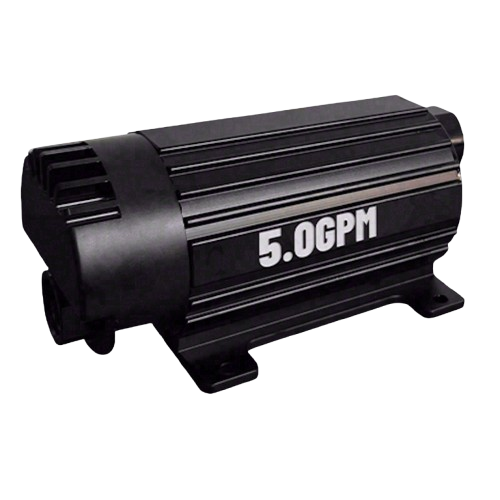
An external brushless fuel pump, often called an inline or external electric fuel pump, is mounted outside the tank – typically on a chassis rail, inside a fuel cell, or along the frame. It draws fuel through a suction line and pushes it toward the engine. Because it sits in the airstream rather than in fuel, it relies on airflow and its own housing for cooling rather than fuel immersion. External pumps are common in performance, racing, marine, and auxiliary-fuel applications where high flow, easy access, or a custom fuel cell is involved.
For distributors, the external format is the specialist, higher-margin line: easier to demo on a bench, simpler to swap trackside, and well matched to builders who already run custom fuel systems. The trade-off is more exposed plumbing and a different packaging and fitment story than a standard in-tank program.
Key differences between in-tank and external brushless pumps
The table below summarizes the five dimensions that matter most to a distribution buyer. The detailed discussion follows.
| Dimension | In-tank brushless | External brushless |
|---|---|---|
| Installation and packaging | Drops into tank; module or hanger kit | Bolt-on to rail or cell; inline kit |
| Cooling, noise, heat | Fuel-cooled, quiet, protected | Air-cooled, audible, heat-exposed |
| Flow and application | OEM-range and moderate performance | High flow, racing and auxiliary |
| Serviceability and cost | Tank drop to service; assembly cost | Track-side swap; lower labor cost |
| Inventory and MOQ | Broad SKU base, steady reorder | Narrow SKU, project-driven |
Installation and packaging requirements
In-tank pumps ship as a pump, a hanger, or a complete module, and they must match the tank’s sender, flange, and strainer layout. That means more application-specific SKUs but a single boxed assembly at the point of sale. External pumps ship as a smaller inline body with fittings, mounting hardware, and sometimes a pre-filter and wiring pigtail; packaging is compact and the same body can serve many vehicles with the right bracket. Distributors should weigh box size and weight too – in-tank modules are bulkier to warehouse per unit of flow than external bodies.
Cooling, noise and heat management
Submersion keeps an in-tank pump close to fuel temperature and quiet, which suits passenger and fleet use where cabin noise matters. An external pump runs in ambient air, so it is more exposed to under-hood or under-body heat and is audibly louder under load. For continuous-duty and high-horsepower builds, that heat exposure is exactly why external high-performance fuel pumps are paired with heat shields, airflow, and sometimes a fuel-cooler in the return line.
Flow capacity and application range
In-tank brushless pumps cover the wide OEM and mild-performance band, where packaging and noise drive the spec. External brushless pumps scale to higher flow because the body is not constrained by the tank neck or a single module footprint, and they can be staged in parallel for very high demand. The practical rule for buyers: standardize in-tank for catalog coverage, and reserve external for the flow ceiling and custom builds.
Serviceability and replacement cost
Replacing an in-tank pump means tank access, so the common distribution strategy is a complete hanger or module swap rather than a bare pump repair. External pumps win on serviceability – a clamp or two and the unit is off the rail, which is why racing and marine channels prefer them. Replacement cost tends to be lower in labor but similar in unit price; the difference shows up in downtime, not the part.
Inventory and MOQ considerations for distributors
In-tank programs demand a broader SKU base because each application can differ in flange, depth, and sender, so forecast accuracy and MOQ discipline matter early. External programs are simpler to stock: fewer bodies cover more applications, and project demand (race season, marine commissioning) is easier to batch. A balanced distributor often carries a deep in-tank matrix for recurring demand and a tight external line for the performance and auxiliary tail.
Spec your brushless fuel pump line with KOLA MOTOR
Request flow curves, pressure data, and private-label pricing across in-tank and external brushless platforms.
Which option fits your distribution business
The right mix depends on your channel. A multi-brand automotive distributor should lead with in-tank coverage for steady, high-turn demand, then add an external line for the performance and marine tail. A performance- or racing-focused brand can invert that, carrying a narrow external range with deep flow options and treating in-tank as a courtesy line. Engineering and OEM buyers usually need both, specified by application rather than by preference.
For complete builds, review fuel pump hangers and assemblies so the in-tank side of your catalog ships as a ready-to-fit unit with integrated ports, filters, and senders. KOLA MOTOR supports both form factors with flow and pressure validation, customization of housing, connector, harness, and packaging, plus OEM, ODM, and private-label programs.
Frequently asked questions
Which type is easier to stock for a multi-brand distributor?
In-tank pumps are easier to sell but harder to stock because of application-specific flanges, depths, and senders. External pumps are easier to stock because fewer bodies cover many vehicles, though they serve a narrower, project-driven demand. Most distributors keep a deep in-tank matrix and a tight external line.
Do in-tank pumps require custom fuel cell fitment?
Not usually. In-tank pumps are designed for production fuel tanks with standard sender housings, so they drop into the OEM flange. A custom fuel cell typically uses an external pump or a dedicated in-cell hanger, so custom cell fitment is the exception rather than the rule for standard in-tank units.
Can external pumps support higher flow for racing applications?
Yes. External brushless pumps are the common choice for high-flow and racing builds because the body is not limited by the tank neck or a single module footprint, and multiple units can be staged in parallel. An external electric fuel pump also stays accessible for trackside swaps, which matters in competition service.
What packaging differences exist between in-tank and external pump kits?
In-tank kits are larger boxes containing the pump, hanger or module, strainer, and sometimes the sender, while external kits are compact, holding the inline body, fittings, mounting bracket, and wiring. The packaging difference affects warehouse footprint and freight cost per unit of flow, with in-tank modules taking more space.
Conclusion
The in-tank vs external fuel pump choice is not either-or for most distributors – it is a mix. In-tank brushless pumps deliver the quiet, fuel-cooled, high-coverage core of a catalog, while external brushless pumps cover the high-flow, service-friendly performance and auxiliary tail. Stock the in-tank matrix for recurring demand, keep a tight external line for the flow ceiling, and standardize on a supplier that validates flow, pressure, and endurance across both form factors.
Partner with KOLA MOTOR for your fuel pump program
OEM, ODM, private-label, and custom engineering across in-tank and external brushless platforms, with flow and pressure validation.
