

If your team is starting to evaluate the brushless fuel pump category for a distribution program, an OEM project, or an engineering rebuild, the first step is a clear mental model of what the device is and how it differs from the brushed pumps most buyers already know. This guide explains the brushless fuel pumps category for procurement and engineering staff who are new to it, covering internal structure, operating principle, and where the technology fits in a fuel system.
What is a brushless fuel pump
A brushless fuel pump is an electric fuel pump that uses a brushless DC (BLDC) motor instead of the brushed commutator motor found in traditional pumps. In a conventional brushed pump, carbon brushes press against a rotating commutator to switch current to the rotor windings. In a brushless design, that switching is handled electronically by a controller, and the rotor carries permanent magnets while the stationary stator carries the windings. The result is a pump with no brush wear path, no brush spark, and a motor that the controller can run at variable speed.
For buyers familiar with older pump types, the practical difference is durability and control. A brushed pump has a fixed mechanical commutation limit set by brush life. A brushless pump moves that function into electronics, which is why the category is now common in high-performance fuel pumps, continuous-duty assemblies, and fuel systems that need precise pressure control.
| Attribute | Brushed pump | Brushless pump |
|---|---|---|
| Commutation | Mechanical brushes and commutator | Electronic, controller driven |
| Wear part | Brushes wear out | No brushes to wear |
| Spark risk | Brush spark possible | No commutation spark |
| Speed control | Essentially on or off | Variable via controller |
| Typical lifespan | Limited by brush life | Longer, cooler running |
Key components
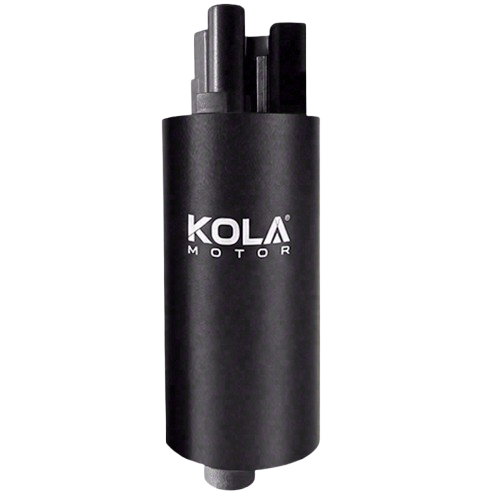
A brushless in-tank fuel pump is a sealed assembly with five functional groups. Understanding each one helps engineering buyers specify the right unit and helps procurement ask the right validation questions.
Brushless motor
The motor is the heart of the pump. The stator holds the copper windings and stays stationary, while the rotor carries permanent magnets. Because there are no brushes or commutator, the only moving contact is the bearing system, which is why brushless motors tolerate long run times and high duty cycles.
Pumping module
The pumping module converts rotor rotation into fuel movement. Most modern units use a turbine (centrifugal impeller) or a gerotor set. The impeller draws fuel in axially and pushes it out through the pressure side. The choice between turbine and positive-displacement gerotor affects flow curve shape and pressure stability, which is why KOLA MOTOR supports custom flow-curve engineering for OEM programs.
Fuel inlet and outlet
The inlet sits below the pump and usually connects to a strainer or pre-filter that protects the module from debris. The outlet carries pressurized fuel to the system and normally includes a one-way check valve that holds residual line pressure after shutdown, reducing restart vapor lock. Pressure is typically expressed in bar or kPa depending on the market.
Sealing system
The sealing system keeps fuel contained and keeps the motor cavity dry. It includes the shaft seal, housing O-rings, and bonded joints. For aggressive fuels such as E85 or methanol, seal and housing material selection is a specification item, not an afterthought, because compatibility drives long-term leak performance.
Controller interface
The controller interface is the electrical connector and harness that links the pump to its controller or vehicle ECU. This is the defining external feature of a brushless pump: the motor cannot commutate itself. The interface carries power and, in most designs, rotor-position or command signals, so the connector type, pinout, and harness must be defined during sourcing.
How it works
The operating sequence has three linked stages: the controller drives the rotor, the rotor drives the pumping module, and the controller sets the speed to match demand.
Electronic commutation and rotor drive
Instead of brushes physically switching current, the controller energizes the stator windings in a timed sequence. It knows where the magnet rotor is from position sensors or from sensorless back-EMF detection, then switches the next phase to pull the rotor around. This electronic commutation is what removes the brush wear path and lets the motor run efficiently at a chosen speed.
Fuel intake and pressurization
As the rotor spins, the pumping module pulls fuel through the inlet strainer and accelerates it through the impeller or gerotor. The outlet check valve builds and holds system pressure. Flow and pressure are coupled: at a fixed speed the pump follows its flow curve, while a drop in downstream pressure lets more volume pass, which is why a controller is useful for holding a target pressure.
Speed control via controller
The controller varies motor speed using a command signal or pulse-width modulation (PWM) from the ECU. At low demand the pump slows and draws less current; at high demand it speeds up to maintain pressure. This closed-loop behavior is the main efficiency advantage over a brushed pump that essentially runs at full speed whenever powered.
Why brushless technology improves efficiency and durability
Removing the brushes changes the failure mode. A brushed pump degrades as the commutator and brushes wear; a brushless pump’s wear is limited to bearings and seals, both of which run cooler because there is no commutation spark or brush friction. The controller also lets the pump operate only as hard as the application needs, which lowers electrical load and heat.
For B2B programs this translates into longer service intervals and better behavior with alternative fuels. KOLA MOTOR validates selected development programs for up to 2,000 hours of continuous endurance and applies a 5-step quality process – incoming material inspection, assembly process control, flow and pressure validation, leak, noise, and electrical testing, and final inspection with traceability. For applications that only need a low-pressure supply, such as carbureted engines or lift duties, review our low-pressure fuel pumps as a complementary option.
Specify your brushless fuel pump with KOLA MOTOR
Request flow curves, sample evaluation, and private-label pricing for brushless and high-performance fuel pumps built to your specification.
Frequently asked questions
What does electronic commutation mean in a fuel pump?
Electronic commutation means the controller switches current between the stator windings electronically instead of using mechanical brushes and a commutator. It detects rotor position and energizes the correct phase in sequence, producing rotation without brush contact. This is the core difference between a brushless and a traditional brushed fuel pump.
Does a brushless fuel pump need a controller to operate?
Yes. A brushless motor has no mechanical commutator, so it cannot start or run on plain DC power alone. It needs a controller – either built into the pump housing or mounted externally – to perform commutation and to set motor speed. When sourcing, confirm whether the supplier provides the controller or expects you to supply one.
What materials are used in the fuel-wetted components?
Fuel-wetted parts commonly use stainless steel for the housing and shaft, engineering plastics such as PPS or PA for the impeller and module, and fluorocarbon or nitrile seals depending on the fuel. For E85 or methanol duty, material compatibility should be confirmed against the supplier’s datasheet, because the wrong seal compound will fail early. The examples here are illustrative and must be verified per part number.
How is flow and pressure verified during production?
At KOLA MOTOR each unit passes flow and pressure validation as part of the 5-step quality process, supported by leak, noise, and electrical testing before final inspection. Buyers should ask for per-unit or batch test data and the test method, because documented flow and pressure numbers are the most practical way to compare suppliers before a first order.
Conclusion
A brushless fuel pump is an electric pump whose motor is commutated electronically rather than by brushes, giving it longer life, cooler running, and controller-based speed control. For procurement and engineering teams new to the category, the key takeaways are the five component groups, the three-stage operating principle, and the fact that a controller is required for the motor to run. KOLA MOTOR supports OEM, ODM, joint development, and private-label brushless programs with customizable flow curve, pressure, connector, harness, filter, housing, and packaging.
Talk to the KOLA MOTOR technical team
From component selection to custom assemblies, our engineers support distributor and OEM programs with validation data and sample evaluation.
